Rajinder Singh’s new show, Saffron Crossings, is on at Wei-Ling Gallery until 26 September. He talks to Chin Huat about the ship that carried three generations of his family across the Bay of Bengal, the red he had to invent a name for, and why he doesn’t quite trust a painting to sit still.
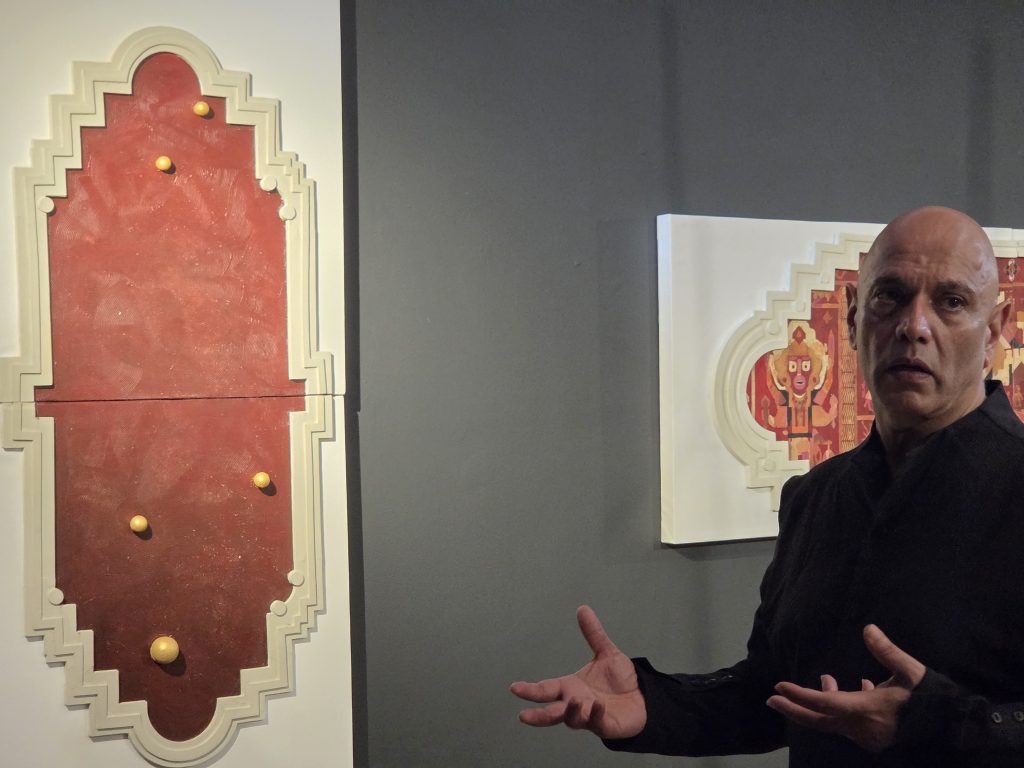
By Ong Chin Huat
Three generations of the same family, and the same ship. That’s the plain fact sitting underneath Saffron Crossings, Rajinder Singh’s new exhibition at Wei-Ling Gallery in Brickfields, running from 1 August to 26 September. The SS Rajula, built in Glasgow in 1926, spent nearly fifty years carrying families across the Bay of Bengal between Madras, Penang, Port Klang and Singapore, and it carried Singh’s grandfather, then his father, then Singh himself, on that same route, before it was decommissioned in 1973. His last show at Wei-Ling, Saffron Surrender, stayed close to land: colonial Ipoh, his Punjabi childhood, the family house. This one goes out to sea.
Singh, born in Ipoh in 1964, trained first as an engineer before turning to fine art, and now works between painting, sculpture, performance and choreography from his studio in London. His practice tends to circle back to the body, what it carries, what it’s made to hold, how it remembers. I spoke to him over email, about a red he had to invent a name for, an eight-foot bamboo ship built with a Malaysian collaborator, and a new book about gesture and memory.
Saffron Surrender was rooted in colonial inheritance and Punjabi childhood memories in Ipoh. Saffron Crossings takes you out to sea. What prompted that shift?
Saffron Surrender began with the house, the garden, the Punjabi world of my childhood. Those memories were personal, but shaped by a colonial history already present in the buildings around us. While making that work I became interested in the question just beyond it: how had these lives arrived here? The SS Rajula gave that question a route. The ocean has very little of the reassurance of land, it repeats itself, horizon and distance become almost abstract. I began to think of the sea as an interval, an extended space between one world and another. I was interested in what people carry with them, and how those things change along the way.
Your grandfather, your father and then you crossed the same ocean on the same ship, across three generations. At what point did it deserve to be the subject of an entire body of work?
My grandfather travelled on the Rajula, then my father, then me. The same ship passed through three generations of the same family. It began to feel like a family archive in its own right. I started thinking about what a ship carries beyond the people named on the passenger list, the ways of speaking, dressing, moving, remembering, the small habits formed long before anyone boards. Those things travel too. That was when the Rajula became large enough to hold the exhibition. I kept coming back to one question: what crosses, when a person crosses?
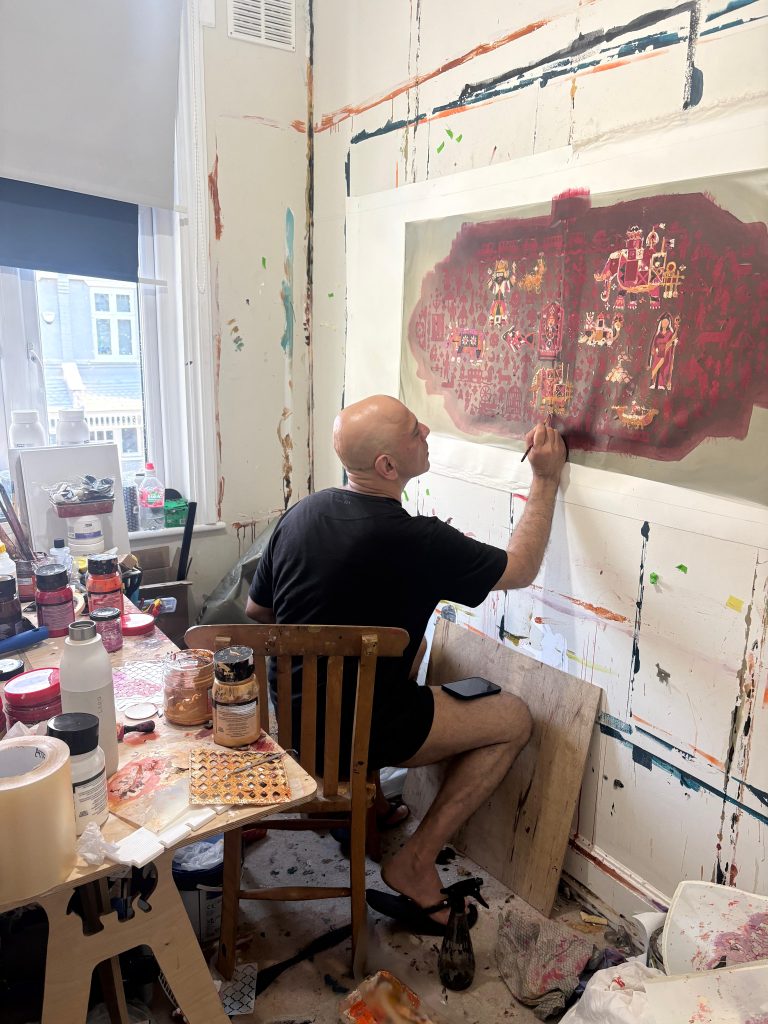
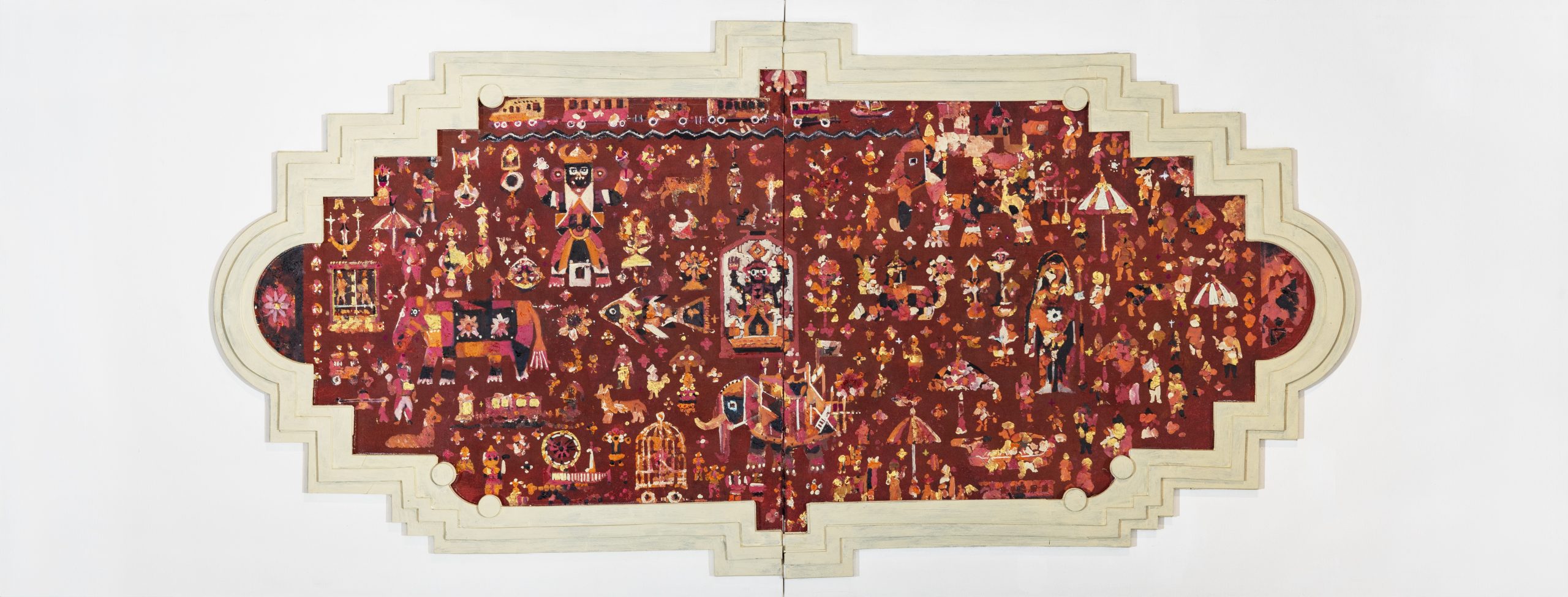
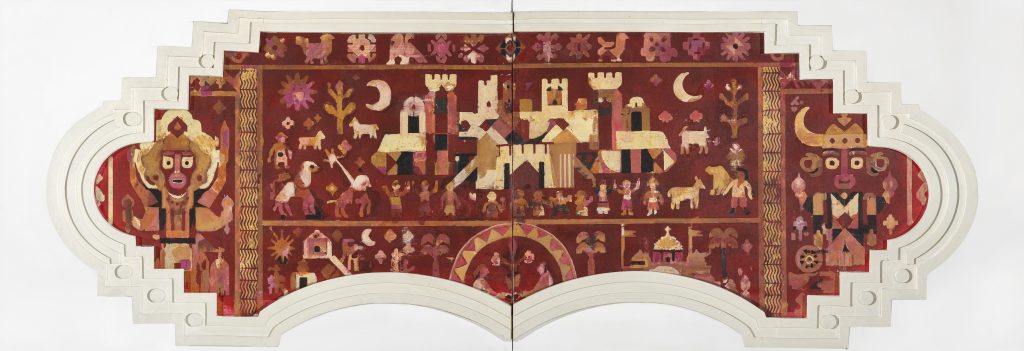
The palette is dense and red, almost all-consuming. How did colour become structural rather than simply visual?
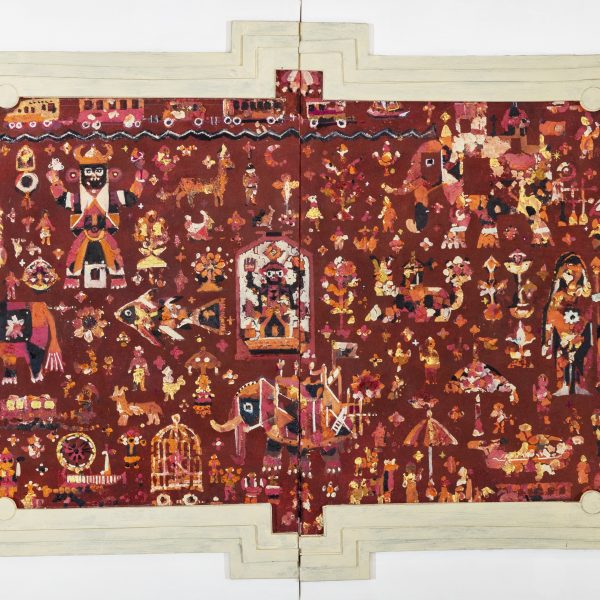
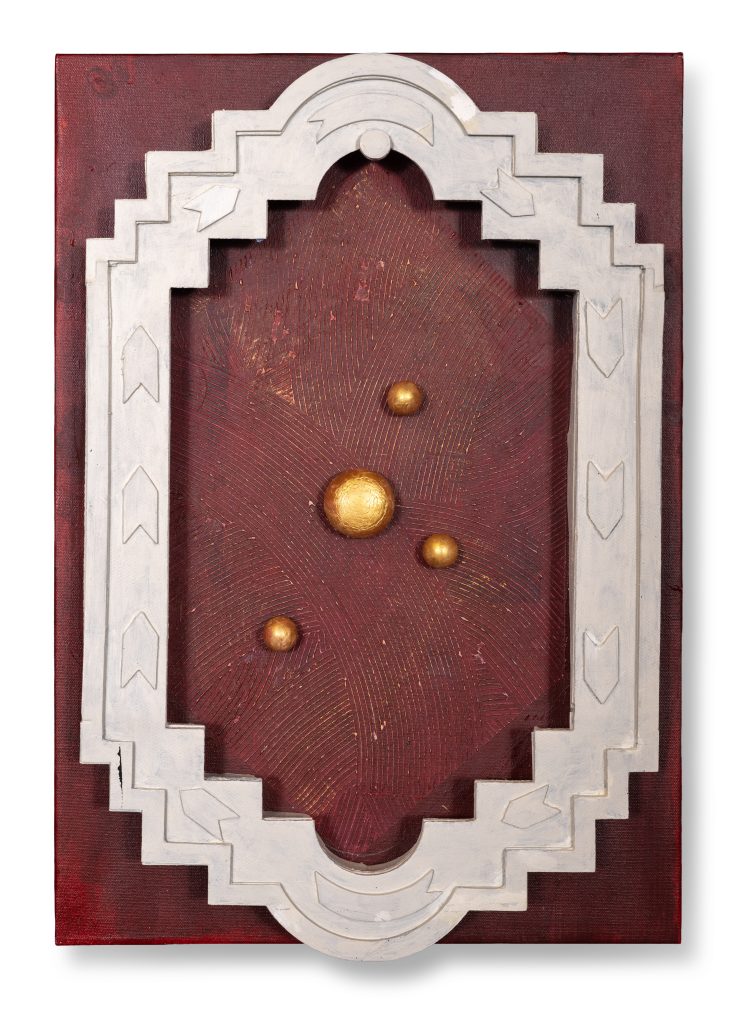
The red came slowly, through mixing and repetition, until it began to feel like more than a colour. I started calling it Rajula Red because it had become part of the atmosphere of the work. There’s something bodily and textile about it, at times it moves towards rust, dried pigment, ceremonial cloth. It can also carry the warmth of an interior remembered from childhood. It changes how the images sit together. A bird, a building, a figure can occupy the same field with equal force. It holds the surface together while keeping everything slightly under pressure.
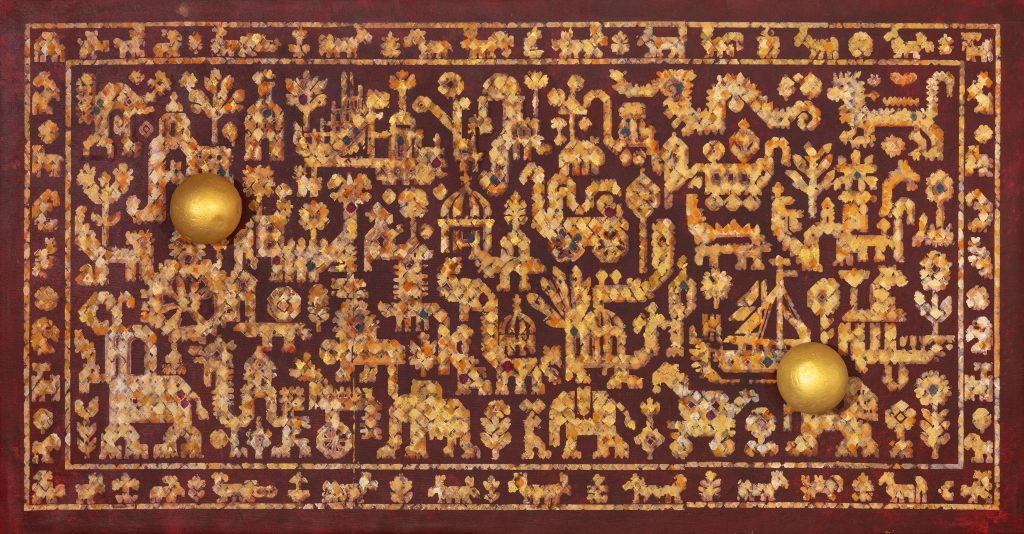
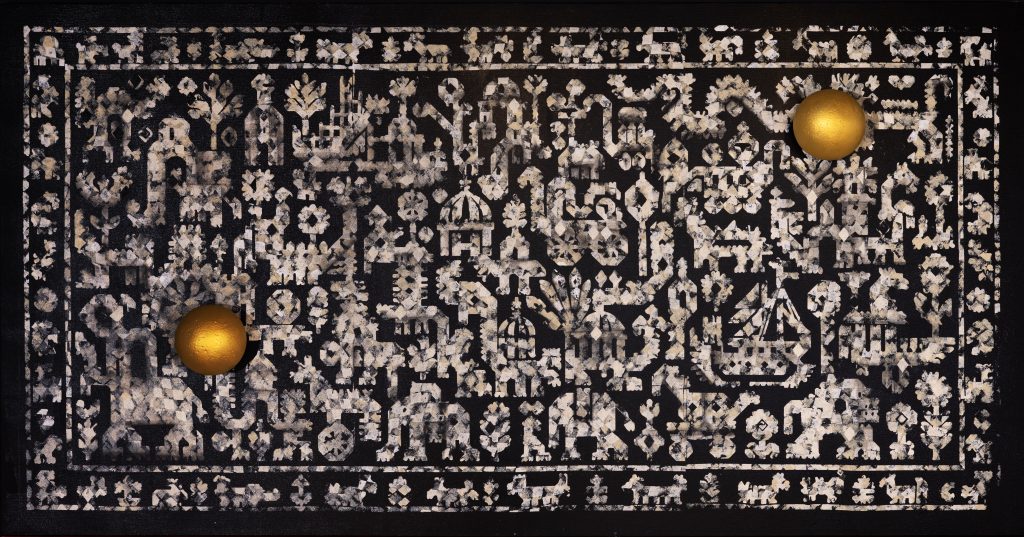
You’ve spoken about “migrant ecologies” as an ongoing concern. What does that mean to you, and how do the gold spheres in this show extend it?
I use migrant ecologies to think about migration as a condition that produces relationships. Movement carries a world into contact with another world. Forms adapt, habits persist in altered circumstances, a plant appears in a different garden, a word changes accent. The gold spheres entered the paintings as bodies with very little description. Their refusal of a fixed identity became important, they can register as passengers or seeds, coordinates, weights, celestial bodies. Each sphere places pressure on the field around it. The painting has to accommodate an arrival. That’s close to how I understand a migrant ecology. Arrival changes what is already there.
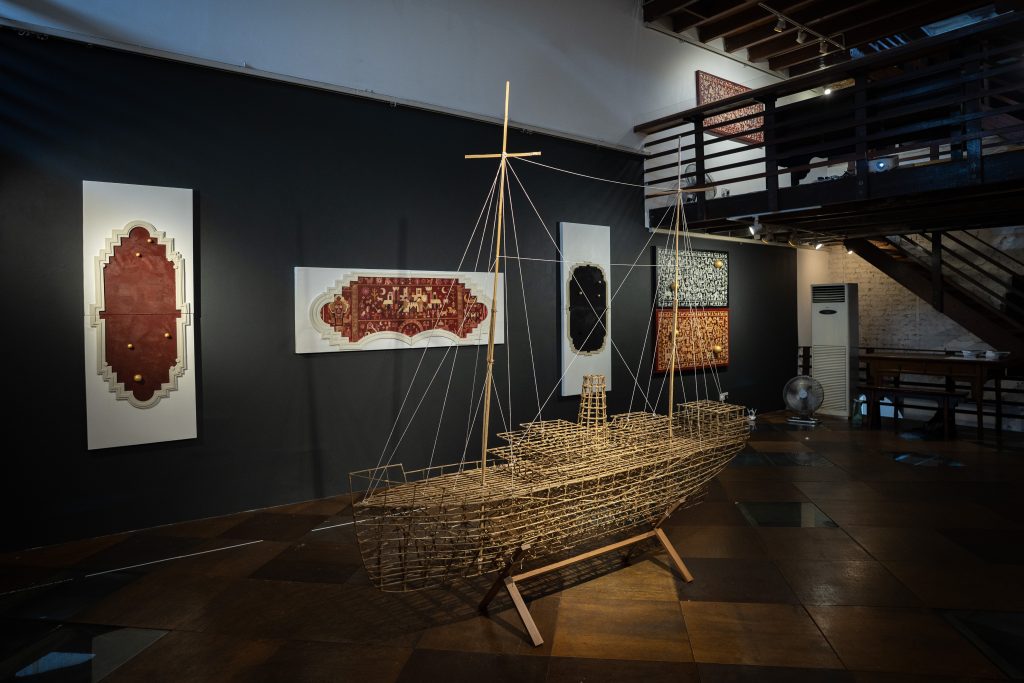
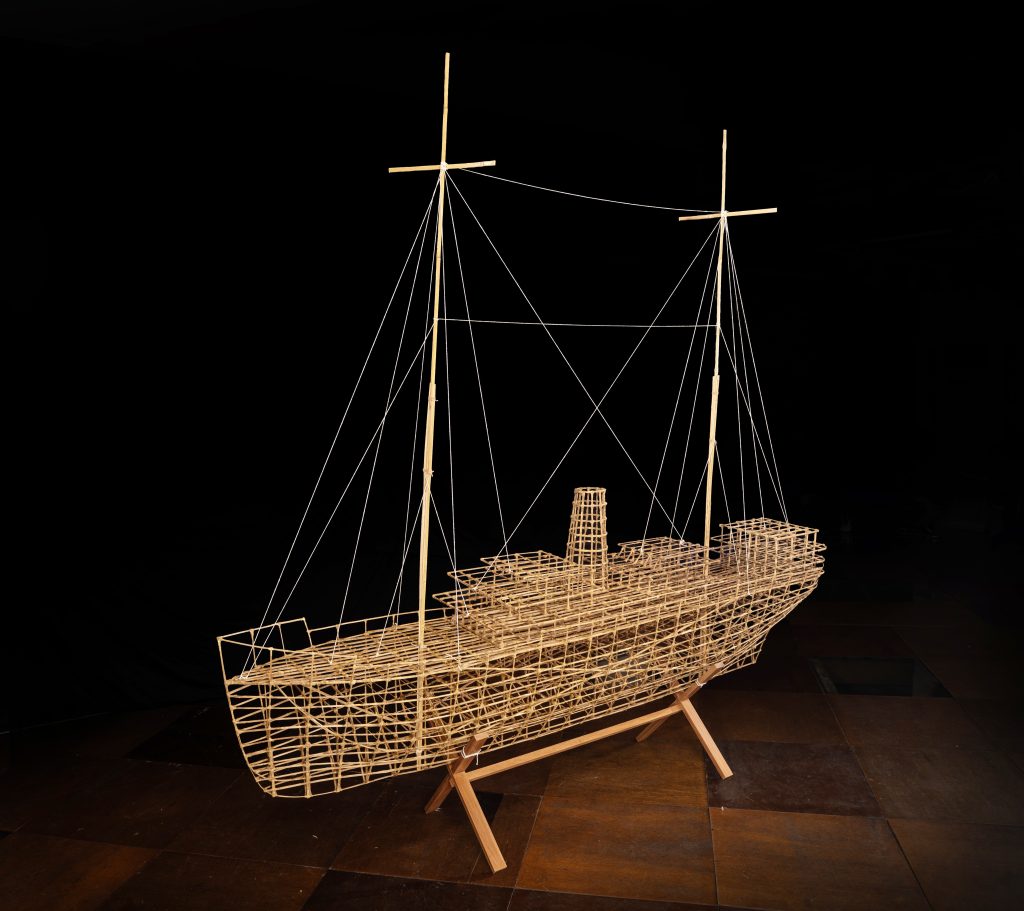
The eight-foot bamboo model of the Rajula was built with Malaysian artist Lee Mok Yee. What did that collaboration teach you?
I’d imagined the Rajula as something close to a three-dimensional drawing, with the hull permeable, the structure carrying as much meaning as the silhouette of the ship. Lee understood very quickly how bamboo could make that possible. Bamboo has its own discipline, it bends, resists, carries tension, and the maker has to listen to what the material permits. A ship built in Glasgow and remembered through journeys between India and Malaya was being remade in Malaysia through bamboo and paper, through knowledge held in local hands. Collaboration taught me to let the work exceed the image I first carried into the room.
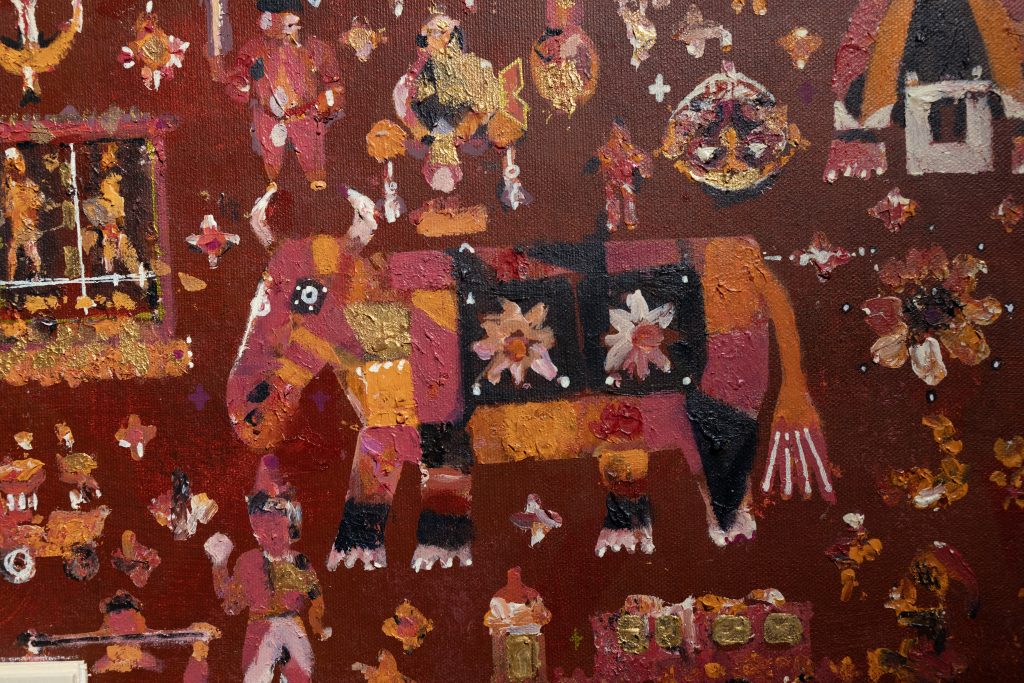
You also posted a performance piece of yourself drawing the Rajula. What does performance give you that the paintings can’t?
Performance returns the ship to the scale of the body. When I draw the Rajula across the gallery floor, I have to travel its length, the line is produced through displacement. Choreography has always taught me that knowledge can sit inside an action before it becomes language. The mark acquires duration, it starts to behave like a wake. The audience sees the ship arrive through the labour of its drawing, while my body performs a small crossing of its own.
Your new book, The Fugitive Gesture, feels in conversation with this show. What’s it about, and why now?
It follows The Turban Imaginary and looks at what the body remembers through gesture. I became interested in how knowledge passes from one body to another through repetition, a gesture can carry history without becoming fixed. That’s where the idea of the fugitive comes in, the gesture exists in the doing, and always keeps something beyond capture. Saffron Crossings asks what the body carries forward through migration and the ship. The Fugitive Gesture stays closer to the hand, to cloth, to the small actions through which memory survives.
Saffron Crossings runs at Wei-Ling Gallery, Brickfields, from 1 August to 26 September. Entry is free.