Four new releases, four different worlds: a dial cut from a 4.5-billion-year-old meteorite, a chronograph built for the cigar lounge, a GMT redesigned for the dark, and a rally-raid partnership built on shared geometry. Bell & Ross’s latest round of novelties doesn’t pick a lane, and mostly gets away with it.
Bell & Ross has built its whole identity on one idea: the cockpit instrument, reborn on the wrist, all exposed screws and legible dials and a square case wrapped around a round one. What’s notable about this season’s releases isn’t a new design language, it’s how far the brand is willing to stretch the old one, from outer space to a French cigar house to the Saudi desert, without ever quite abandoning the DNA.
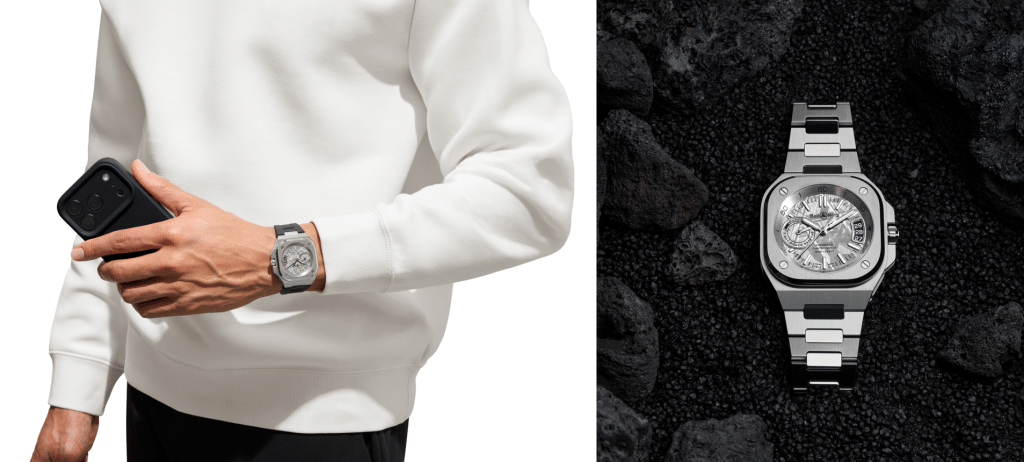
The strangest of the four, and the best argument for the house’s instrument-watch instincts, is the BR-X5 Meteorite. Limited to 250 pieces, its dial is machined directly from a fragment of the Muonionalusta meteorite, an iron meteorite pulled from the Norrbotten permafrost in northern Sweden in 1906, dated to roughly 4.5 billion years old, nearly the age of the solar system itself. Cut and polished, the material reveals a Widmanstätten pattern, a crystalline structure that forms only through millions of years of cooling in zero gravity and cannot be replicated by hand, which means no two dials in the run are identical. There’s no brass base beneath it either; the dial feet pass straight through the raw stone. Bell & Ross wraps that in a 41mm open-worked steel case, four screws visible at the corners, running on the in-house BR-CAL.323, COSC-certified, with roughly 70 hours of power reserve. It’s a watch selling geology as much as horology, and for once that’s not an exaggeration.

Further from the instrument-panel brief, and closer to the humidor, is the BR-05 Chrono S.T. Dupont, a 150-piece collaboration with the French maison better known for lighters and cigar cutters than movements. The watch itself, a 42mm steel-and-rose-gold chronograph with a brown sunray dial, is almost the least interesting part of the package: it arrives inside a Macassar ebony box that unfolds into a working humidor holding fifty cigars, accompanied by an S.T. Dupont Ligne 2 lighter and cutter engraved to match. It’s a watch built to be one accessory inside a larger ritual, which is either a clever piece of lifestyle merchandising or a fairly honest admission that the watch alone wasn’t the point.
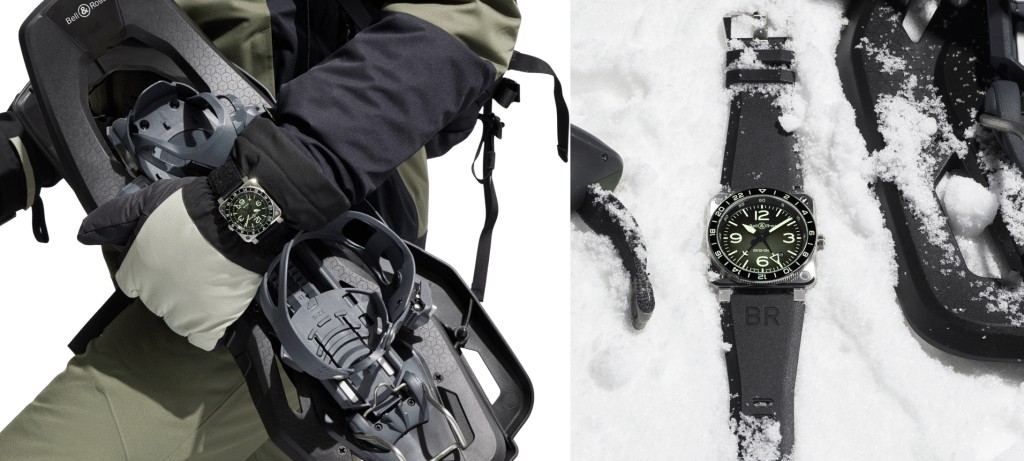
Closer to home is the BR-03 GMT Green Lum, a 500-piece update to the brand’s travel-focused GMT that trades novelty materials for a more tactical proposition: the dial fades from black to a deep green top to bottom, evoking, per the brand, the Northern Lights, and both the hour markers and the ceramic bezel are treated in Super-LumiNova C3, a pigment that throws a genuinely long-lasting green glow, roughly ten hours after exposure to light. The GMT function itself, a second hand tracking a 24-hour scale on the rotating bezel, is nothing new for Bell & Ross; what’s new is how usable the watch becomes once the lights go out, which is arguably the more honest selling point for a travel watch than the colour alone.
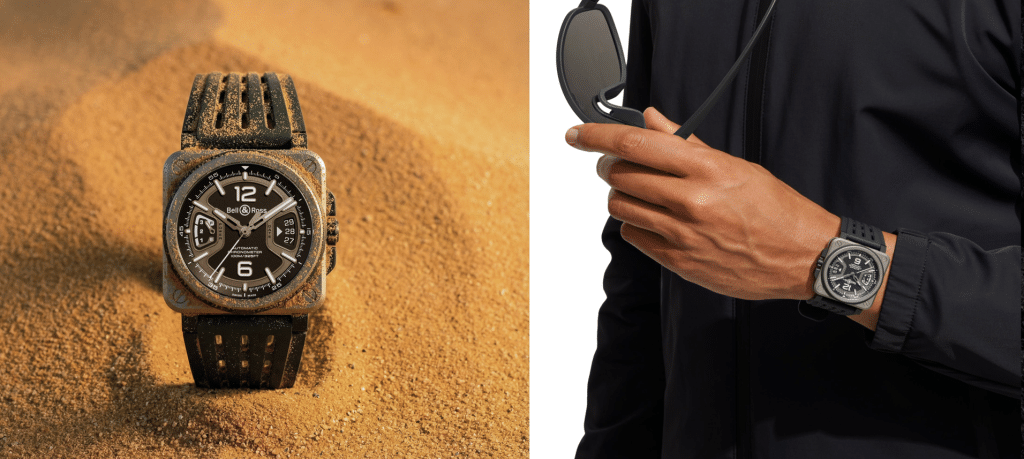
The fourth piece isn’t new hardware so much as a new context: Bell & Ross has signed on as official timing partner to Defender Rally, arming the team’s drivers with the BR-X3 Black Titanium for the 2026 World Rally-Raid Championship, which opens in January. The pitch here leans hard on shared design logic, Bell & Ross’s co-founders describe the square-cased BR-X3 and the boxy Defender D7X-R as speaking the same visual language, robust, angular, built for function over flattery. It’s a stretch as marketing copy, but the watch itself, grade 2 titanium, COSC-certified, built to survive the same desert stages as the car, doesn’t need the metaphor to make its case.
Taken together, the four releases read less like a coherent collection than a company testing its own range, how far an instrument-watch brand can travel from the cockpit before it stops being one. On this evidence, further than expected, and not yet too far.