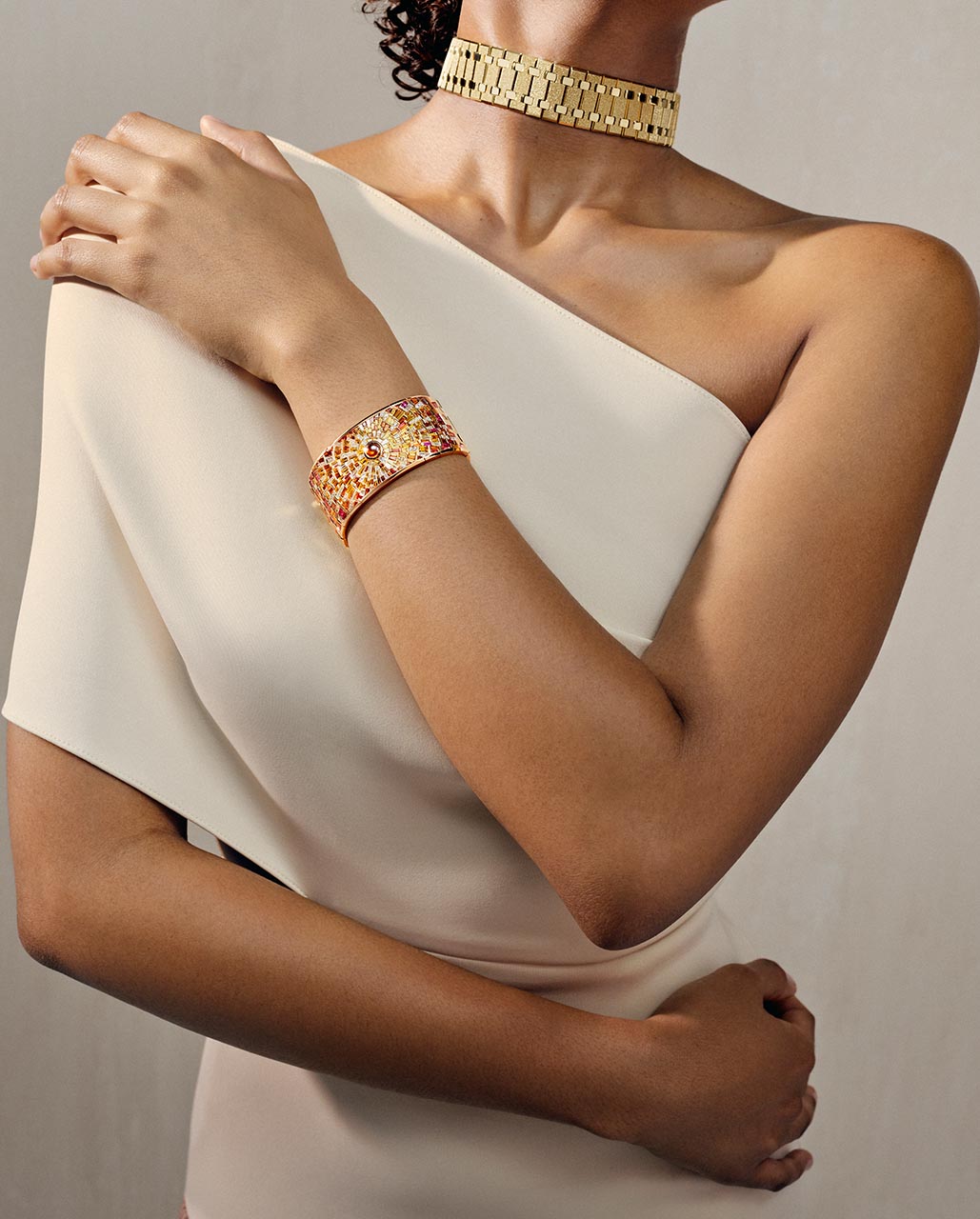
With Royal Oak Joaillerie, Audemars Piguet turns the architecture of its most famous watch into cuffs, collars and high-jewellery statements, proving that an icon can still find new ways to surprise.
There are some designs so familiar that changing them risks upsetting the entire equation. Audemars Piguet’s Royal Oak is one of them. Gérald Genta’s 1972 creation, with its sharply defined geometry and integrated bracelet, has become one of the most recognisable silhouettes in modern watchmaking.
Now Audemars Piguet is asking a rather interesting question: what happens when you remove the watch altogether?
The answer is Royal Oak Joaillerie, a new jewellery collection that takes the visual language of the Royal Oak bracelet and pushes it into an entirely different realm. The result is not jewellery merely inspired by a watch. Instead, the bracelet itself becomes the starting point for cuffs, necklaces and earrings, its familiar links enlarged, reshaped, gem-set and sometimes transformed almost beyond recognition.
It is a clever move because the Royal Oak has always possessed something of the jewel about it. When the watch first appeared, its combination of satin-brushed surfaces and polished chamfers gave steel an unusually precious quality. The light catching those alternating finishes created an effect closer to faceted jewellery than conventional sports watchmaking.
That same tension between engineering and ornament now drives the new collection.
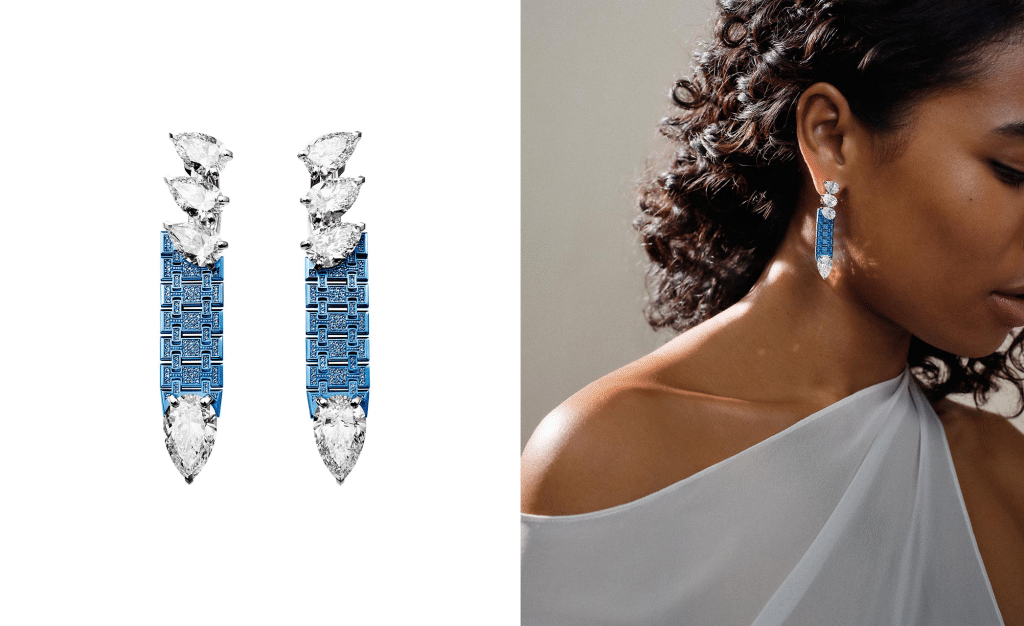
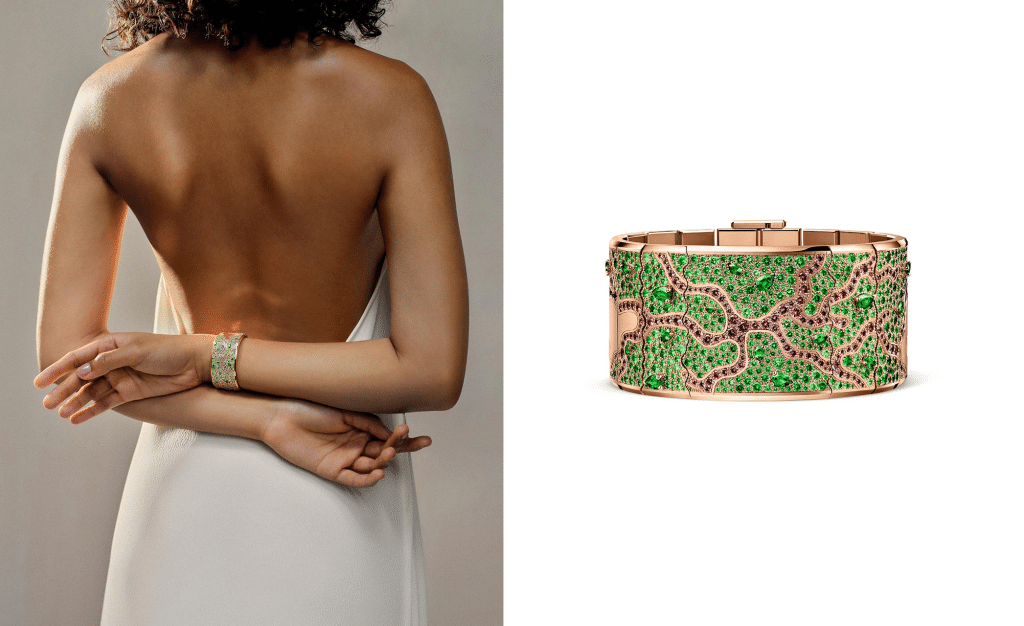
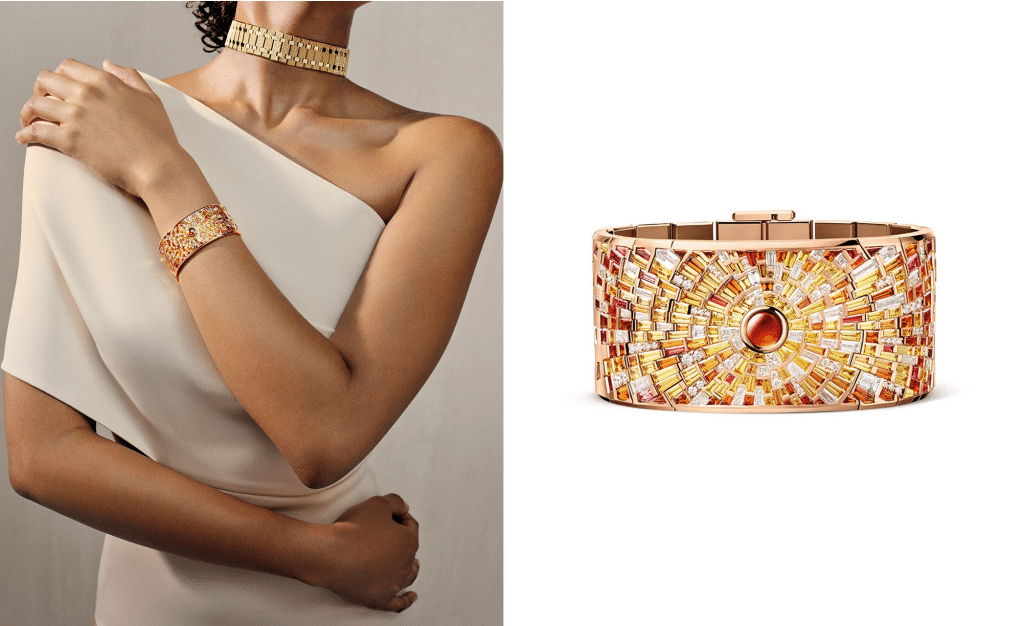
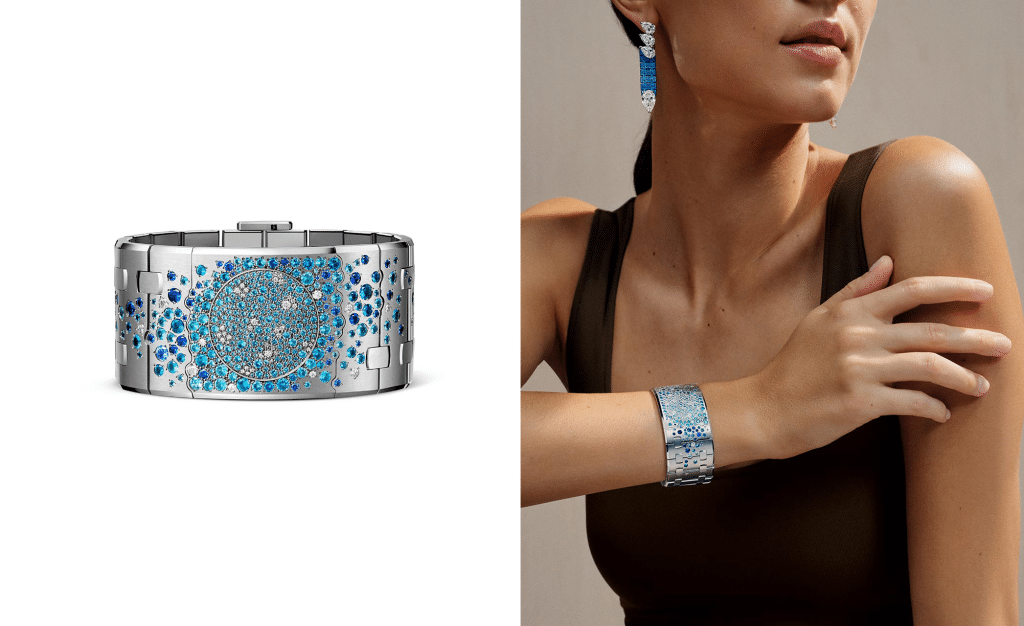
At the more dramatic end sits Dream of Joux, a series of one-of-a-kind creations inspired by the landscape surrounding Audemars Piguet’s home in the Vallée de Joux. The Swiss valley is translated not literally, but through colour, texture and stone-setting: deep blues recalling night skies and frozen lakes, vivid greens and pinks suggesting the changing landscape, and warmer tones catching something of the region’s shifting light.
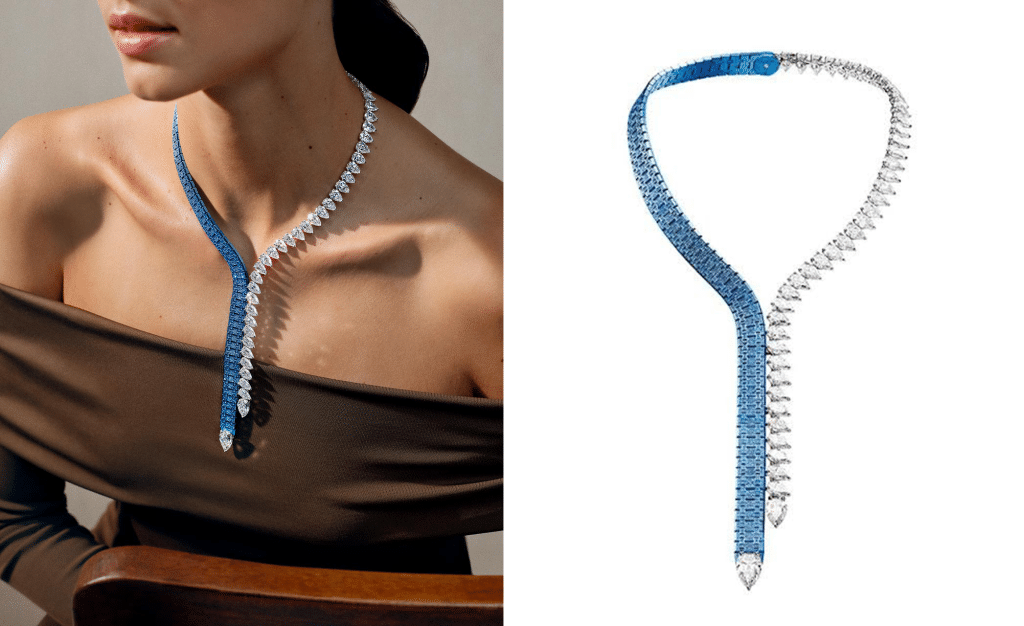
Among the standout pieces is a tie necklace that falls asymmetrically down the body, pairing pear-shaped diamonds with anodised blue titanium links set with blue sapphires. It is part high jewellery, part sculpture, and refreshingly difficult to categorise. Matching drop earrings carry the same architectural language on a smaller scale.
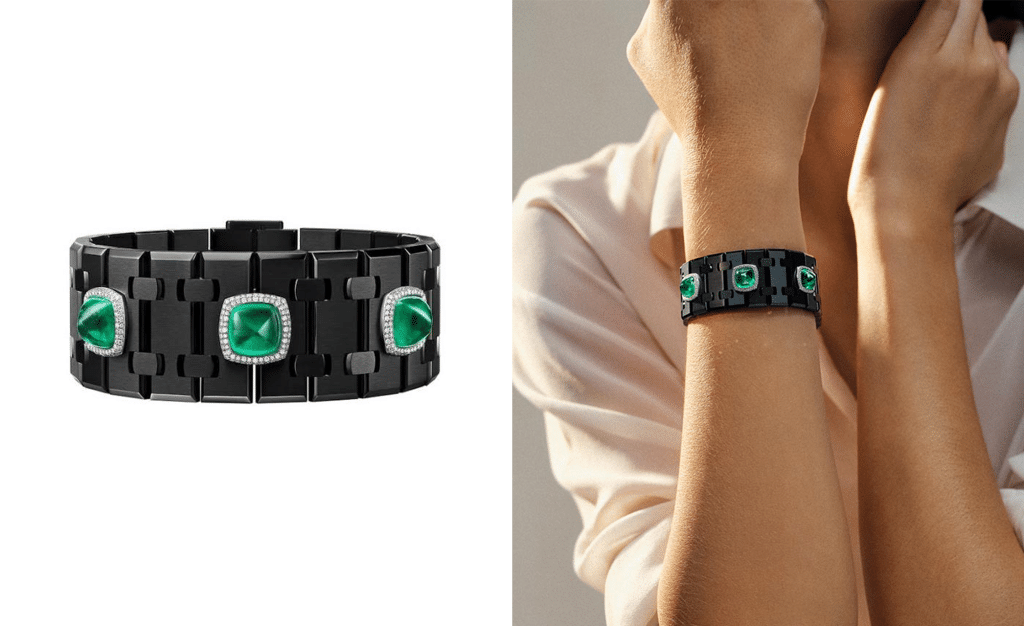
Then there is Risoud Eclipse, which turns considerably moodier. Named for the Risoud Forest and inspired by the Vallée de Joux’s connection with celestial observation, the inaugural necklace and cuff combine black PVD titanium with sugarloaf emeralds framed by brilliant-cut diamonds.
The contrast is striking. Matte-black links give the pieces an almost industrial severity, while the emeralds interrupt them with flashes of saturated green. It is perhaps the clearest example of Audemars Piguet allowing its watchmaking vocabulary to migrate into jewellery without becoming too polite in the process.
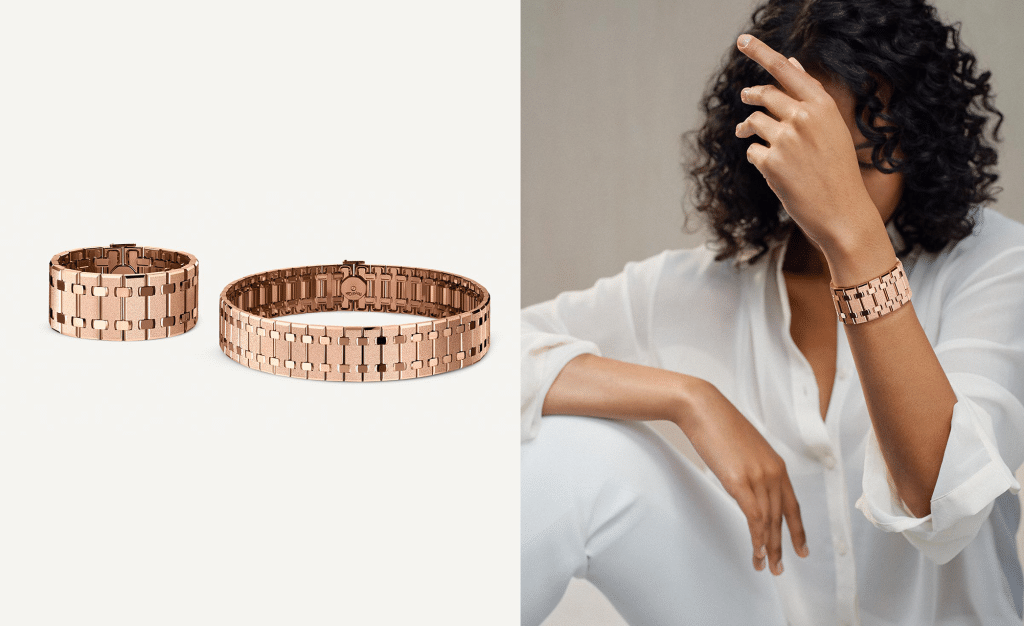
A separate series in Frosted Gold provides another bridge between the Manufacture’s past and present. The finish, developed with jewellery designer Carolina Bucci in 2016 for the Royal Oak’s 40th anniversary, adapts an old Florentine technique to create a shimmering surface that catches light from countless tiny facets. Here it appears across cuffs and necklaces in white, pink and yellow gold, bringing a softer luminosity to the Royal Oak’s otherwise rigorous geometry.
None of this represents an abrupt detour for Audemars Piguet. Jewellery has long existed alongside the company’s watchmaking. By the 1980s, demand for watches with welded bracelets had prompted the Manufacture to establish its own jewellery workshop, eventually leading to increasingly elaborate gem-set creations and bespoke Haute Joaillerie pieces.
That expertise became particularly visible with the launch of Audemars Piguet’s Haute Joaillerie watch collection in 2013 and later creations such as the Diamond Trilogy and Sapphire Orbe, pieces that already blurred the boundary between timepiece and jewel.
Royal Oak Joaillerie simply takes that idea one step further: this time, the jewellery does not need a dial at all.
Audemars Piguet CEO Ilaria Resta describes the collection as a gateway between past and future, and that is perhaps the most convincing way to understand it. The Royal Oak remains present in every link and surface, but it is no longer confined to the wrist or even to watchmaking.
For a design more than half a century old, that feels surprisingly contemporary.
And perhaps that is the real trick here. Audemars Piguet has not reinvented the Royal Oak by disguising it. It has simply allowed one of its most familiar details to become the main event.